Music generated from approximate brain simulation data... Just for the fun of it :)
Data is generated using Neuron and CoreNeuron:
https://github.com/BlueBrain/CoreNeuron
https://github.com/nrnhines/nrn.git
With the help of this tutorial:
https://github.com/nrnhines/ringtest
Once the tutorial is successfully completed, the following file is used to produce the music:
coreneuron_tutorial/sources/ringtest/coreneuron_data/spk1.std
This file contains the timestamp of each spike. This is translated into a MIDI file using the mido library.
https://github.com/olemb/mido

Scientific visualization architect | Science communicator | Monofin/Marathon swimmer
Thursday, May 10, 2018
Fractals love in high resolution
After all these years, still in love with fractals. Those ones are rendered with Brayns, on a 40MPixel curved display. Source code is here:
https://github.com/favreau/Brayns-Research-Modules/tree/master/fractals
https://github.com/favreau/Brayns-Research-Modules/tree/master/fractals

Thursday, April 5, 2018
Menger Sponge in Brayns
 Based on the very cool shader toy from Inigo Quilez, I ported the code to ISPC and exploited the vertorized units of the CPU to render the Menger sponge in real time:
As usual, the code is there:
https://github.com/favreau/Brayns-Research-Modules/blob/master/fractals/ispc/renderer/
More information on ray-marching and distance functions can be found on Inigo's website
Thursday, March 1, 2018
Contours and wireframe in ray-tracing
I created this simple shader that attempts to draw geometry contours using ray-tracing. The idea is to send extra rays, parallel to the camera ray, and translate according to the normal of the intersected surface. If the parallel ray hits the same geometry, it's not a contour.
That somehow seems to work, but that still needs a bit of refinement.
The code is in the ContoursRenderer:
https://github.com/favreau/brayns-research-module/tree/master/cartoon
And can be easily used with the Brayns viewer, with the following command line arguments:
braynsViewer --module cartoon --renderer contours


That somehow seems to work, but that still needs a bit of refinement.
The code is in the ContoursRenderer:
https://github.com/favreau/brayns-research-module/tree/master/cartoon
And can be easily used with the Brayns viewer, with the following command line arguments:
braynsViewer --module cartoon --renderer contours


Sunday, February 18, 2018
Transfer function editor in Jupyter Notebook
Just created a Jupyter Notebook widget for volume rendering with Brayns. Also improved the volume rendering module for better performance and image quality.


Install it with:
pip install ipyTransferFunction
The code sources are:
Transfer Function: https://github.com/favreau/ipyTransferFunction
Brayns: https://github.com/BlueBrain/Brayns
Volume rendering module: https://github.com/favreau/brayns-research-module


Install it with:
pip install ipyTransferFunction
The code sources are:
Transfer Function: https://github.com/favreau/ipyTransferFunction
Brayns: https://github.com/BlueBrain/Brayns
Volume rendering module: https://github.com/favreau/brayns-research-module

Saturday, February 10, 2018
Sharing my experimental modules (plugins) for Brayns
I created this Github repository to share my experiments with Brayns. It's all about shaders, volume rendering, custom cameras, etc.
https://github.com/favreau/brayns-research-module
Feel free to download, try, contribute, star the repo, etc :) Hope this will be helpful to anyone willing to enjoy ray-tracing based computer graphics.


https://github.com/favreau/brayns-research-module
Feel free to download, try, contribute, star the repo, etc :) Hope this will be helpful to anyone willing to enjoy ray-tracing based computer graphics.


Tuesday, January 23, 2018
Advanced interactive volume rendering
Realtime volume rendering using:
Source code: https://github.com/favreau/Brayns/tree/aidenoiser
Demo running on Quadro K6000 NVIDIA GPU (960x540 pixels)
- Phong and blinn shading. The normal is defined by a vector going from the voxel position to the barycenter of the surrounding voxels, weighted by opacity. I got the idea in the middle of the night, thanks to a strong winter storm that prevented me from getting a good rest, but that seems to work ok :-)
- Soft and hard shadows
- Deep learning denoiser (OptiX 5)
Source code: https://github.com/favreau/Brayns/tree/aidenoiser
Demo running on Quadro K6000 NVIDIA GPU (960x540 pixels)
Sunday, January 21, 2018
Brayns is rendering everything, everywhere!
Thanks to Docker, Brayns is now available on any platform (Windows, Mac and Linux), in a couple of clicks only:
First download and start the Brayns renderer:
docker pull bluebrain/brayns
docker run -ti --rm -p 8200:8200 bluebrain/brayns
Then download the corresponding web UI:
docker pull bluebrain/sauron
docker run -ti --rm -p 8080:8080 bluebrain/sauron
And connect to the UI using the following address:
http://localhost:8080/?host=localhost:8200
That's it, you're done! Enjoy, and crontribute! :-)
First download and start the Brayns renderer:
docker pull bluebrain/brayns
docker run -ti --rm -p 8200:8200 bluebrain/brayns
Then download the corresponding web UI:
docker pull bluebrain/sauron
docker run -ti --rm -p 8080:8080 bluebrain/sauron
And connect to the UI using the following address:
http://localhost:8080/?host=localhost:8200
That's it, you're done! Enjoy, and crontribute! :-)
Thursday, January 11, 2018
Brayns empowered by OptiX's DLDenoiser
Tuesday, January 9, 2018
Happy new year 2018!

For most people, it is a stretch of the imagination to understand the world in four dimensions but a new study has discovered structures in the brain with up to eleven dimensions -- ground-breaking work that is beginning to reveal the brain's deepest architectural secrets.
https://www.sciencedaily.com/releases/2017/06/170612094100.htm
Thursday, November 16, 2017
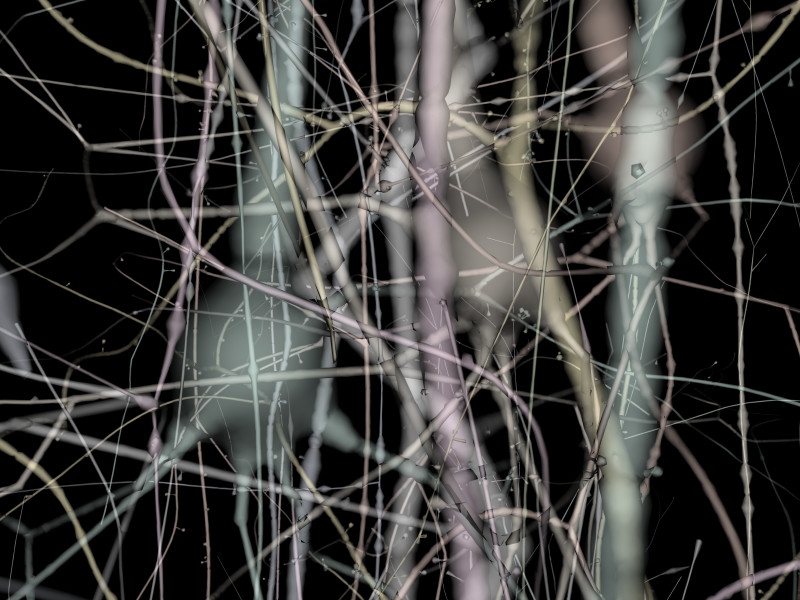
Visualization of brain simulation (87TB dataset)
Bellow a few frames of the video I lead in the context of the Blue Brain project. The full video should soon be available on various channels. Stay tuned.

The video was produced using Brayns, the visualizer I created for visualizing high quality and neuroscience related large datasets.
The rendering technique is of course ray-tracing with a bit of global illumination to enhance the rendering of neuronal activity.


The video was produced using Brayns, the visualizer I created for visualizing high quality and neuroscience related large datasets.
The rendering technique is of course ray-tracing with a bit of global illumination to enhance the rendering of neuronal activity.


Visiting K Computer in Kobe
Many thanks to my good friend Syoyo for making it possible to visit the K Computer in Kobe. Great time, great people! Inspiring :)


Monday, September 25, 2017
Real-time raytracing of animated nD geometry
Let's face reality, 3D is dead, long live nD. Now that the Sol-R ray-tracer is more or less complete (for what it was initialy designed for anyway), it's time to move on to the next level. I added the Hypercube scene to the Sol-R viewer so that we can now play around with n dimensional hypercubes, thanks to the Delphi code, by cs_Forman (http://codes-sources.commentcamarche.net/source/33735-hypercubes).
Now that it's pretty clear that our world has more than 3 dimensions, I am hoping that Sol-R can now help understanding what n dimensional geometry looks like when it intersects our 3D world.
The code is there:
https://github.com/favreau/Sol-R
PS: The code was written while watching the inspiring Christopher Nolan Interstellar movie :-)
Now that it's pretty clear that our world has more than 3 dimensions, I am hoping that Sol-R can now help understanding what n dimensional geometry looks like when it intersects our 3D world.
The code is there:
https://github.com/favreau/Sol-R
PS: The code was written while watching the inspiring Christopher Nolan Interstellar movie :-)
Subscribe to:
Posts (Atom)